Know About Your Miami Cast Iron | Questions Answered
Origin · Markings · Heritage
Your MIAMI skillet was built to sit on a stove and cook dinner, day after day, and it’s been doing exactly that for the better part of a century. Favorite Stove & Range Co. made these pans for their budget line, priced below their better-known Favorite Piqua Ware cookware — but built with the same quality that let it compete with the other foundries.
Your pan may have passed down through your family — or maybe you found it yourself, at an estate sale or a flea market table. Either way, it’s spent a hundred years earning its keep at someone’s stove, and now it’s yours to use.
Here’s how to date your Miami skillet by its logo, and why it’s worth treasuring.
Quick Reference To Place Your Skillet In Time
| Logo | Est. Era | Identification |
|---|---|---|
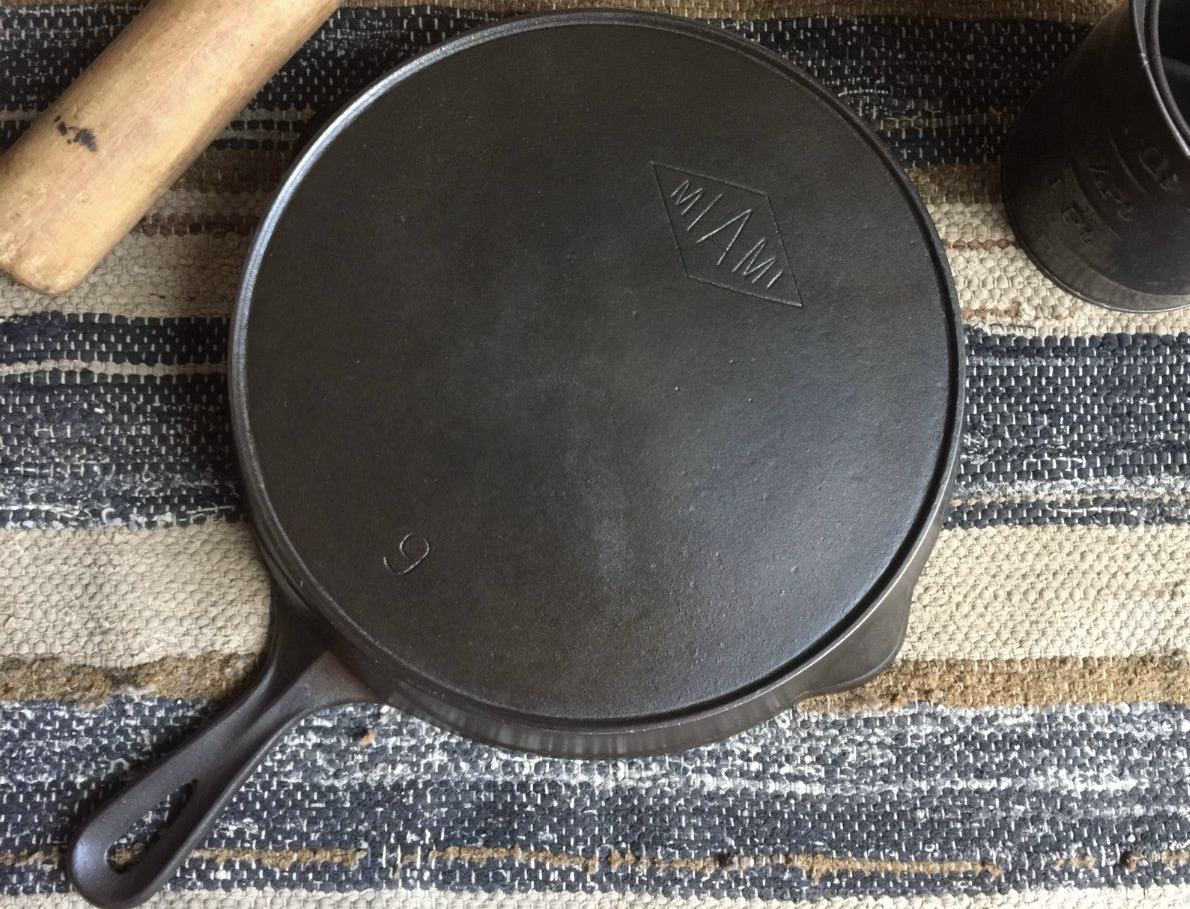
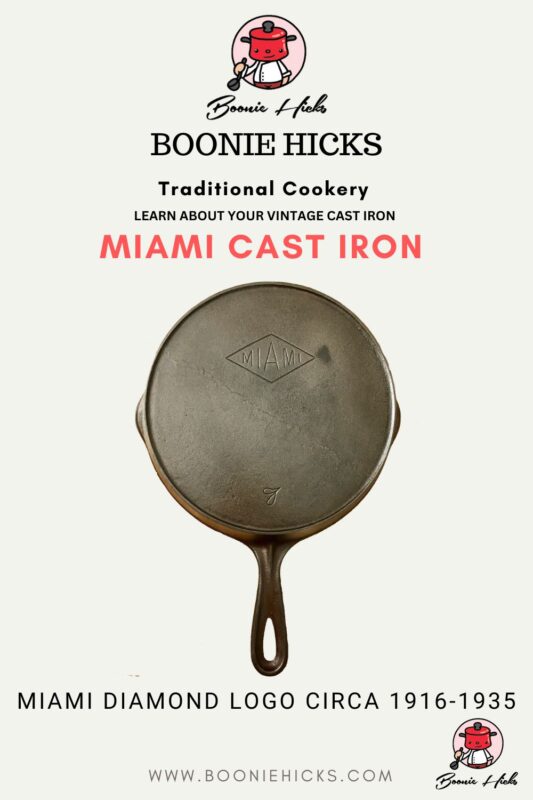
| Diamond Only (Miami Daimond) | circa 1916-1935 | Miami name inside a diamond |
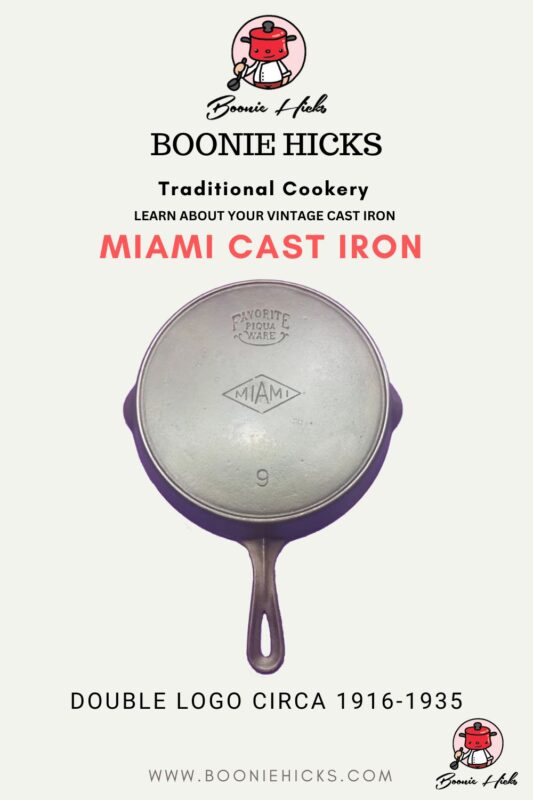
| Diamond + Smiley (Dual / Double Logo) (Miami with Smiley) | circa 1916-1935 | Favorite Piqua Ware (Smiley) Miami name inside a diamond |
Collectors generally consider the Diamond-only logo the earlier of the two, though there’s no confirmed date split between them — both are estimated to the same 1916–1935 range.
Table Of Contents
- Living heritage
- Who Made Miami Cast Iron?
- How old is my Miami Skillet?
- Logo Variations
- Is Miami Cast Ironware Any Good?
- Available Sizes
- Is Miami Cast Iron Collectible?
- Purchasing Considerations
- Miami skillets are great everyday useable pans.
Living Heritage
A Piece of Living History
The Budget-Conscious Twenties
If your Miami skillet dates to its earliest years, it likely didn’t start in a kitchen of abundance. From 1917, American home cooks were asked to observe “meatless Mondays” and “wheatless Wednesdays.” The goal was to stretch wheat, sugar, and meat so more could be shipped to soldiers and allies overseas. Nobody was handed a ration book — it was voluntary, nicknamed “Hooverizing” after the man running it. But households took it seriously, swapping in cornmeal, vegetables, and whatever the pantry allowed. Your dependable skillet belonged in a kitchen like that, cooking the same careful meals week after week.
When the war ended, the twenties opened up and the pan kept on cooking for the family. But the “Roaring Twenties” most people picture wasn’t the decade most people actually lived. By 1928, half of American families were still getting by on $2,000 a year or less. Farm incomes, in particular, never fully recovered from their postwar collapse. For a lot of households, a well-made pan at a fair price wasn’t a step down. It was the sound decision — economy skllets were made by families who couldn’t afford the decade’s exuberant reputation.
Cooking Through the Depression
The previous decade’s hardship was just the warm-up . By the 1930s, the meals cooking in your Miami skillet were changing again. Meat went further when it was fried thin and shared across more plates. Potatoes and onions went in the pan with it, maybe a sliced hot dog if there was one to spare.
Hot water cornbread was common too — just cornmeal, boiling water, and salt, fried into patties right on the stovetop instead of baked. Baking meant heating the whole oven for one loaf. That was fuel a lot of families weren’t willing to spend.
When even that stretched too thin, many families turned to whatever greens grew wild and free. Dandelion was one of the most common. It didn’t cost anything but the picking, and a quick turn in the same skillet was enough to wilt it into the rest of the meal.
It wasn’t fancy cooking. It was a pan doing what it had always done, just with less to work with.
Owners And Collectors Guide To Miami Cast Iron Skillets.
Who Made Miami Cast Iron?
Most people assume “Miami” points to Florida. It doesn’t. Your skillet was cast in Piqua, Ohio, a small city in the southwest corner of the state that sits inside Miami County. The name stamped on the pan isn’t a destination — it’s the county where the pan was made.
Miami cast iron was made by the The Favorite Stove and Range Company under William King Boal, who had owned the company since the early 1880s, when it was still based in Cincinnati. In 1887, he moved the entire operation to Piqua, where the town provided land and the company built a new plant from the ground up. The move paid off: Favorite grew into the largest manufacturer in Miami County, and Piqua became known locally as “The Favorite City.”
Miami was never the company’s flagship brand. That distinction belonged to Favorite Piqua Ware, the line that carried the company’s full name. Miami was the more affordable option — built for households working with less, but cast in the same Piqua plant, under the name of the county that made it possible.
You can also learn about the Griswold economy brand called Victor by clicking the link.
How Old Is My Miami Skillet?
Collectors can not precisely pinpoint the manufacture of Miami cast iron. Along with the Favorite Piqua Ware range, all Miami ironware is circa 1916 and 1935. However, collectors consider the standalone diamond logo older than the dual logo.
Some enthusiasts or retailers may estimate the standalone Miami logo to be circa the 1920s and the dual logo to be circa the 1930s. These dates may be accurate, but without certainty, many collectors will identify the standalone Miami as the early logo. And call the diamond plus smiley logo the dual logo, estimating both logos circa 1916-1935.
Logo Variations
As mentioned previously, there are two known Miami logos. The Diamond Miami logo is also called the early logo. And the Diamond Miami plus Smiley Favorite Piqua Ware. This logo is known as the Dual logo or double logo among collectors.
Correctly identify your Miami skillet logo by referring to the graphics below.
Miami Diamond Logo
Dual/Double Logo
Is Miami Cast Ironware Any Good?
Yes. Your Miami skillet was cast in the same Piqua plant, by the same foundry workers, as Favorite’s better-known Piqua Ware line. It shows. Run your hand across the cooking surface and you’ll find the same smooth, glass-like finish you’d expect from a Griswold or Wagner of the same years.
The one real giveaway of its budget status is the sidewalls. Yours likely runs a little shallower than a full-price skillet of the same size. That’s a small cost-saving choice — it holds a bit less than a deeper pan of the same diameter would.
What Sizes Did Miami Come In?
| Sizes Numbers | 3 | 5 | 6 | 7 | 8 | 9 | 10 |
|---|---|---|---|---|---|---|---|
Miami Diamond | ✓ | ✓ | ✓ | ||||
Dual Logo | ✓ | ✓ | ✓ |
Miami skillets came in three sizes — 7, 8, and 9 — and that held true for both logos. If you’ve got one outside that range, it’s worth a second look; nobody’s turned up a confirmed Miami in any other size.
Favorite’s full-price Piqua Ware line ran wider on both ends, but Miami stayed in the middle of the pack, the sizes most families actually reached for on a daily basis.
Is Miami Cast Iron Collectible?
Miami cast iron skillets are collectible pieces of vintage/antique ironware. However, the Miami cast iron is not scarce or as sought-after among collectors. Wagner, Griswold, Favorite Pique Ware, and Wapak have better collectibility, so Miami skillets hold value.
A lower price could offer an entry point to purchase your vintage skillet. And this would be as Favorite Stove and Range originally intended. But if you are selling a Miami skillet, do not expect Griswold prices because it’s not a Griswold.
Purchasing Considerations
Before buying a Miami skillet, carefully inspect the ironware for imperfections. By checking the pan, you can better negotiate a fair price and avoid overpaying and disappointment.
I would not overlook a vintage pan due to imperfections and expect scratches and standard wear over time. But there are a few considerations that will affect the price.
Logo clarity | Collectors prefer a logo with little imperfections. Slight imperfections are only superficial if you are using your skillet daily. |
Logo Variation | A slight preference is given to the dual logo because it includes the favored smiley logo. However, there is no difference in quality between the two logo variations. |
Pitting | Pitting or sulfur damage is not uncommon and will not affect the usability of the skillet. But it will lower the collectibility and value of the pan. |
Flatness | Does the pan sit flat? I won’t overlook a pan if it has a slight wobble. But expect to pay less if the pan has noticeable movement. |
Overall Condition | You should expect scratches and other wear unless you buy a fully restored pan. Many pans this age will have slight pitting on the back. But check for hairline cracks, as this can be a potential fire hazard |
Miami skillets are great everyday useable pans.
Maybe this Miami skillet came down through your family. Or maybe you found it yourself and decided it was worth keeping. Either way, it’s already put in a hundred years of quiet, steady work — through voluntary rationing in one decade, real scarcity in the next, and everyday cooking in between.
Collectors won’t chase a Miami the way they chase a Griswold or a Wagner, and that’s fine. If it’s yours, none of that really matters. You’ve got a piece of vintage cast iron that’s outlived a century — and it’s still got plenty of meals left in it.
Sources & Further Reading
This story wasn’t pieced together from guesswork. It came from Piqua’s local historians, old wartime records, and collectors who’ve spent years patiently tracking down foundry marks most of us would never think twice about. If any part of your Miami’s story has you curious to learn more, these are good places to start.
On Favorite Stove & Range Co. and Piqua, Ohio:
- Piqua Public Library — Favorite Stove
- Wikipedia — Favorite Stove
- Troy Historical Society — William King Boal biography
On identification:
On WWI-era food conservation:
- Library Company of Philadelphia — Food Conservation During WWI
- University of Washington — WWI Home Front exhibit
On 1920s household economics:
On Depression-era cooking: