A Complete Guide To Griswold Small Logo Skillets
Handle · Timeline · Heritage
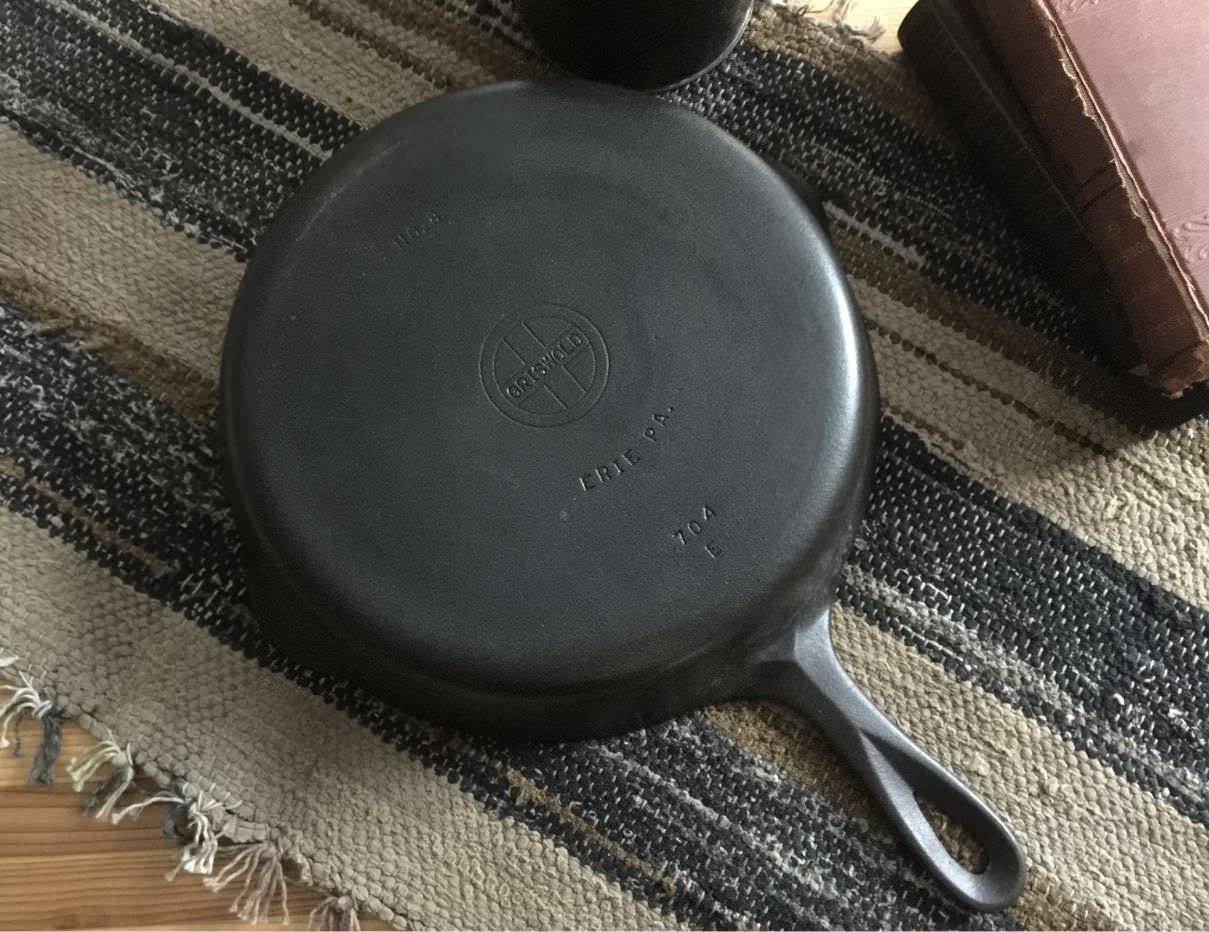
Somewhere between the back of a kitchen drawer and a grandparent’s stovetop, there’s probably a Griswold skillet with a small, unassuming logo stamped on the bottom. No big cross-and-circle trademark taking up half the pan — just a modest little mark that’s easy to overlook.
That small logo throws a lot of owners off. It doesn’t carry the prestige of the earlier large logo years, and if you’ve spent any time searching, you’ve probably noticed collectors treat it almost like Griswold’s afterthought era. But this is also the last chapter of Griswold as Erie, Pennsylvania knew it — pans cast through the Second World War, through ration books and victory gardens, right up to the month the Erie foundry went quiet for good in 1957.
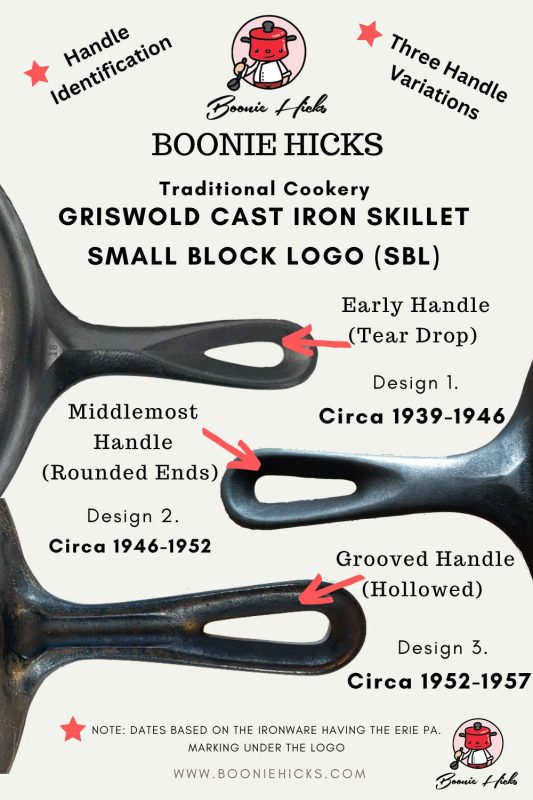
If your pan has a small logo, the handle on the back is your best clue to when it was made. Griswold changed the handle design twice during this run, and each version tells you roughly where your skillet falls in that eighteen-year window.
Identify Your Handle
| Handle Era | Est Years | Collector Term | Identification |
|---|---|---|---|
| Early Handle | 1939–1946 | (Early Handle) | Teardrop-shaped hole, classic triangular reinforcement |
| Middlemost Handle | 1946–1952 | (Late Handle) | Curved rectangular hole, triangular reinforcement still present |
| Grooved Handle | 1952–1957 | (Late Grooved Handle) | Curved rectangular hole, grooved back, no triangular reinforcement |
These years reflect the current best estimate, based on the research of collector RG Meadows. Even among longtime Griswold collectors, exact transition dates are debated — molds were sometimes reused and older stock sold alongside newer pans, so no cutoff year should be treated as gospel.
If you need some simple pointers on what to look for when purchasing a Griswold skillet, check out this article.
Table of Contents
- Living Heritage
- Variations between molds and castings
- Early handle
- Middlemost handle design
- Grooved handle design
- Foundry dates
- Handle collectibility
- FAQs
- Your Griswold
Now that you’ve got a rough date, it’s worth pausing on where your pan actually came from — and what was happening in the kitchens it was made for.
Living Heritage
A Piece of Living History
1939–1946: A Pan Cast In A Changing World
While the guns of Europe and the Pacific were still going, your skillet was poured, shaken out of its sand mold, and shipped off to a hardware store shelf. America was pouring scrap iron and steel into the war effort — pots, pans, and old farm tools hauled to town-square scrap drives to be melted into tanks and shell casings. But a cast iron skillet already seasoned into a family’s kitchen was one of the few pieces of iron that got to stay put. It wasn’t scrap. It was still earning its keep, through a stretch of rationed sugar, rationed meat, and dinners stretched further than they’d ever needed to be stretched before.
1946–1952: Setting Up House
By the time your skillet came off the line, the foundry was running full tilt to meet a country suddenly hungry for new things. The war was over, soldiers were coming home by the millions, and a lot of them were starting kitchens of their own for the first time — a first apartment, a starter home, a wedding registry filled with the things a household needed. Rationing on sugar and meat had mostly ended, but store shelves took longer to catch up — factories that had spent years building tanks and shell casings needed time to retool back to pots and pans. A cast iron skillet wasn’t glamorous. It was practical, affordable, and exactly what a young couple furnishing a kitchen from nothing would reach for.
1952–1957: A Kitchen Looking Forward
By now, your skillet was likely coming home to a kitchen that finally had power running to it. Rural electrification had reached nearly every corner of the country by the end of the 1940s, and for many families, an electric range meant the end of hauling wood, tending a fire, and scrubbing soot off every pot. Cooking got faster, cleaner, and easier to manage. In the middle of all that change sat your dependable skillet with its small Griswold logo. Good things don’t need changing.
With that backdrop in mind, here’s what to actually look for on the handle itself.
Identify And Estimate The Date Of A Griswold Small Logo Skillet
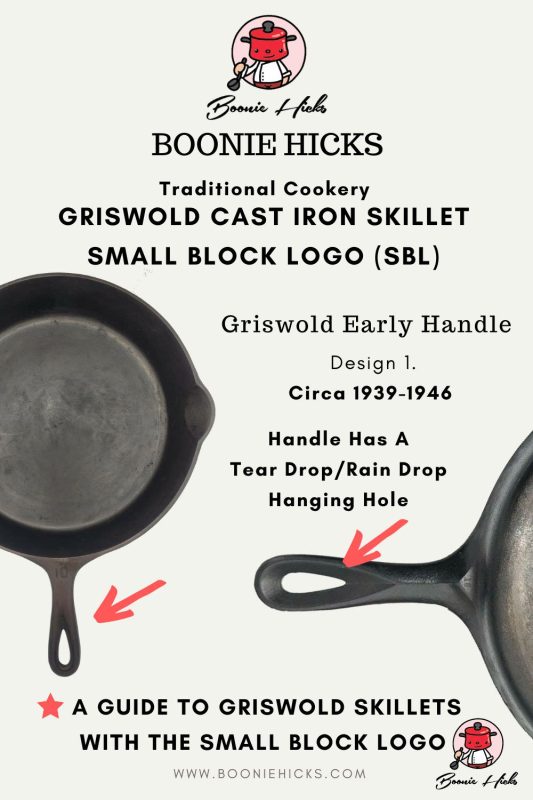
Early Handle (1939–1946)
The handle has a teardrop-shaped hole — pointed at the end nearest the pan, rounded at the tip. Flip the skillet over and you’ll see the classic triangular reinforcement bracing the handle from underneath, the same design Griswold had used for decades before the small logo years.
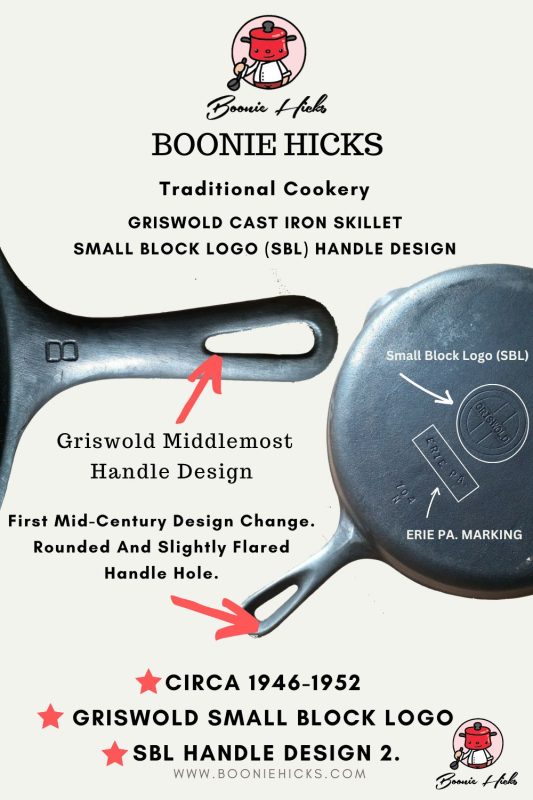
Middlemost Handle (1946–1952)
This handle keeps that same triangular reinforcement, but the hole itself changes shape — it’s now a curved rectangle rather than a teardrop, rounded at both ends instead of coming to a point.
Grooved Handle (1952–1957)
The grooved handle looks identical to the Middlemost from the top — same curved rectangular hole. Flip it over, though, and the triangular reinforcement is gone. In its place is a hollowed groove running the length of the handle’s underside.
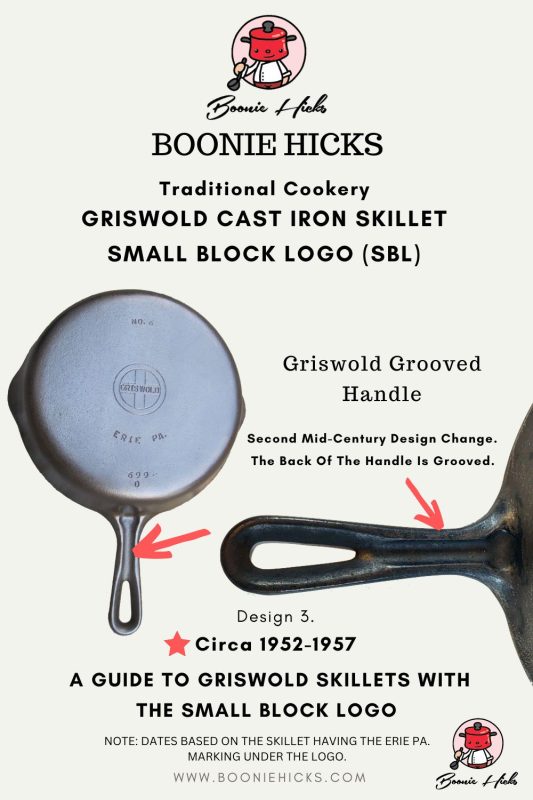
To learn more about dating and identifying Griswold cast iron click this link.
Did Griswold Make More Than One Handle Design At The Same Time?
Almost certainly — a foundry wasn’t going to scrap a working mold just because a newer pattern existed. Old molds likely stayed in use until they wore out or got pulled for something else, and stores kept selling older stock right alongside whatever pans were newest. Backorders needed filling, iron was scarce and money tight after the war, and melting down a perfectly usable mold over a minor handle change wasn’t worth the trouble. Two different handle styles very likely left the same foundry in the same year, more than once.
It’s also why nobody’s ever pinned down an exact year where one handle stopped and the next started. A modern factory can switch designs instantly with a CNC machine. A 1940s or 50s foundry didn’t work that way — a mold ran until it was done, whenever that happened to be.
Is One Handle Design More Or Less Collectible?
Not really, and not because of quality. Collectors recognize the three handle styles, but none is considered more desirable than the others — the deciding factor is always the condition of the pan, not which handle it happens to have. Some collectors do gravitate toward one style over the others, but that’s personal taste, not a market consensus.
The finish tells the same story. Early, middlemost, and grooved handles were all cast and ground to the same Griswold standard, so you shouldn’t expect one style to feel rougher or smoother than another as a rule. Where you do occasionally find a rougher small logo pan, it’s more likely down to pitting, damp storage, or wear over the decades than anything to do with which handle it has. Condition, not handle style, is still what to judge a pan by.
Are you deciding between a skillet with a small logo and a large logo? This article might help you choose a pan best suited to your needs.
Common Questions About Small Logo Skillets
Do all small logo skillets have a smooth bottom?
Not quite — the size 12 kept its heat ring throughout the small logo years, so it doesn’t have a smooth bottom. Every other size (3 through 10) lost the heat ring, which is what most collectors picture when they think “small logo skillet.”
Why did Griswold change the handle design twice?
Nobody knows for certain — and that’s worth saying plainly rather than guessing. Griswold never documented a reason, and no collector research has turned one up. It’s one of the small logo era’s genuine open questions.
My skillet doesn’t say “ERIE, PA” — is it still a real Griswold?
It’s a genuine Griswold pattern, just not cast at the original Erie, Pennsylvania foundry. Ownership of Griswold changed hands twice in 1957 — first to McGraw-Edison, then to Wagner Manufacturing — and Wagner kept using Griswold’s own patterns after production moved to their Sidney, Ohio plant.
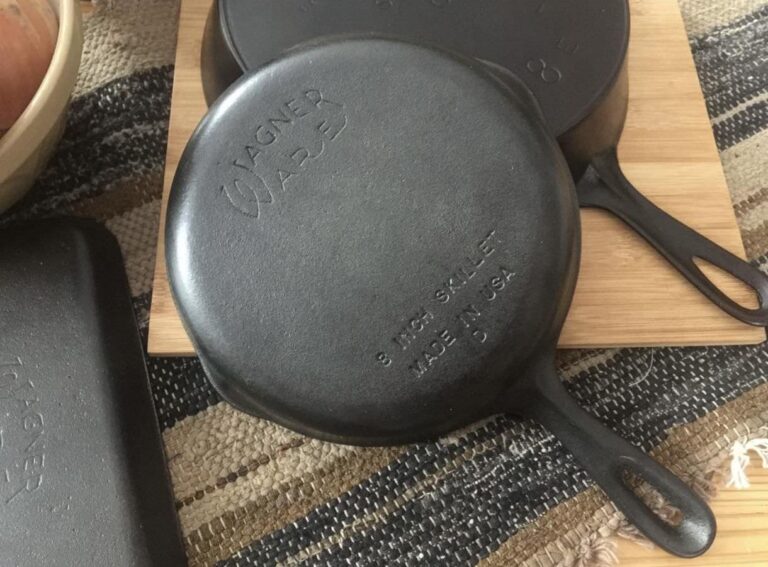
Look for a letter stamped on the back of the handle; that’s often a sign the piece came from the Wagner foundry rather than Erie. These pans are less sought-after by collectors but cook exactly the same as any other Griswold.
These skillets are not as collectible but are great usable skillets that will cook just as well as any Griswold pan. And if you are thinking about buying your first Griswold pan, here is some advice for noncollectors.
Your Griswold Pan
Your small logo Griswold might not carry the prestige of the earlier large logo years, but it’s earned its place all the same. Whichever handle it has — early, middlemost, or grooved — it’s a pan that came out of Erie, Pennsylvania, cast by the same hands and to the same standard as any Griswold before it, right up until the last small logo skillet left the foundry in 1957.
Wherever your pan has been since — a wartime kitchen, a first apartment, a stove that finally ran on electricity — it’s still doing exactly what it was made to do. That’s worth keeping in the kitchen.
References
Identification & Company History
- Cast Iron Collector – Griswold Trademarks & Markings
- Cast Iron Collector – Griswold Skillets
- Griswold Manufacturing Company – Wikipedia
- Wagner Manufacturing Company – Wikipedia
Living Heritage Research
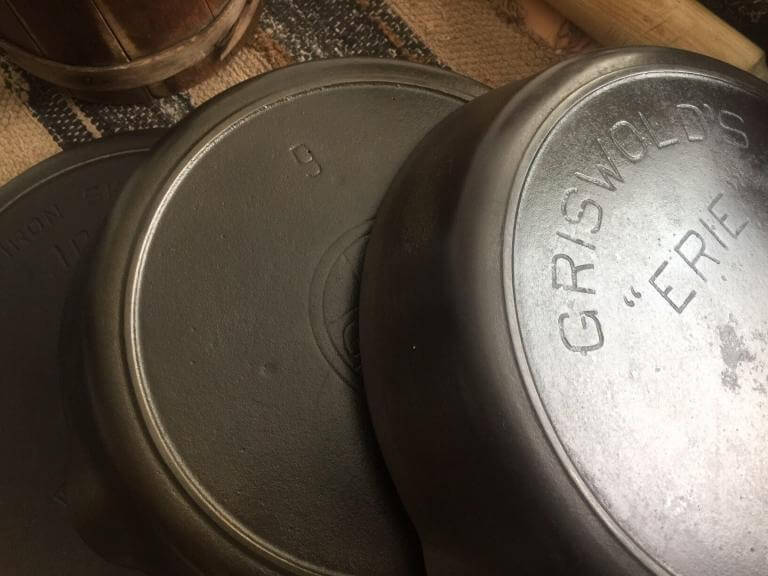
Hi there, I think a Griswold #12 is a small logo pan; it has “Erie” text but a fire ring. Did they make small logo pans with fire rings?
Hi Dave, thanks for getting in touch.
You are right. Your large #12 skillet will have a heat ring despite having a small logo. I’m unsure why Griswold kept the heat ring on the sizes numbers 12 and above, but they did. Great observation
I hope this helps.