Is Vintage Wagner Cast Iron Cookware Any Good?
Wagner Cast Iron · Vintage Cookware · Cast Iron Collectors
Is Wagner cast iron actually good, or does it just live in Griswold’s shadow? If you’ve got a Wagner skillet that’s been in the family for a generation or two, that’s probably the question on your mind. The short answer: yes, and for good reason. Wagner spent decades building a reputation for quality that’s held up just as well as its more famous rival — sometimes better.
Wagner Cast Iron, At A Glance
| Category | Verdict |
|---|---|
| Cooking Surface | Smooth, excellent seasoning results |
| Weight | Light and easy to handle — can warp if overheated |
| Reputation | Trusted craftsmanship, especially pre-1960 |
| Value | Comparable quality to Griswold, often more affordable |
| Look | Understated – Stylized logos |
Table Of Contents
- Living Heritage
- Smooth Cooking Surface & Performance
- Lightweight & Easy to Handle
- Reputation for Quality
- Value & Availability
- Distinctive/Understated Look
- Is Wagner cast iron good?
Living Heritage
A Piece of Living History
In 1891, brothers Milton and Bernard Wagner fired up a foundry in Sidney, Ohio, and started casting skillets built to survive a hundred years in a family’s kitchen without anyone thinking twice about it. The growth surprised even them. Three months in, their crew had doubled from twenty men to forty-one, the furnace pouring through nine thousand pounds of iron a day just to keep pace with demand.
They put a promise behind that pace, and printed it plainly in their own advertisements: they wouldn’t make cookware as cheaply as possible, only “as good as it can be made.” The Wagner brothers meant every word of it — a bet that a family name stamped into cast iron would still mean something decades after the men who founded the company were gone.
They won that bet. Somewhere, right now, a skillet bought new by someone’s great-grandmother is still searing onions for dinner. If yours has come down through a parent or grandparent, it carries more than memory — you’re holding the reason they trusted it in the first place.
Reasons Why Wagner Cast Iron Is Top-Notch
Smooth Cooking Surface & Performance
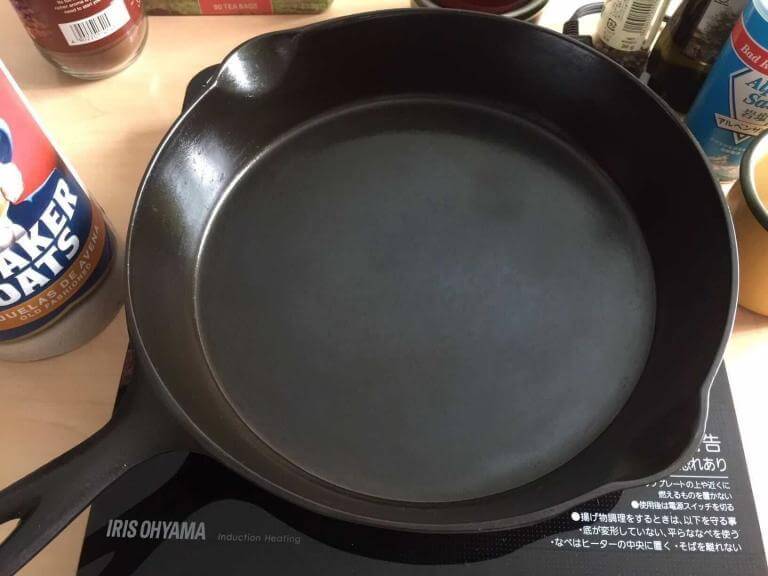
Cast iron straight out of a sand mold has some texture to it — that’s just how the process works. For most of Wagner’s history, that wasn’t the end of the job. Every pan went through a final polishing step at the factory, ground smooth before it ever left Sidney. Every foundry did this back then — it was simply standard practice. What changed is that modern mass production skips the step now, to keep costs down. It’s why an old Wagner still feels glassy under your hand while a lot of new cast iron feels rougher by comparison.
That smoothness isn’t just nice to touch. Food releases easier, and a spatula glides across the surface instead of catching on it.
Lightweight & Easy to Handle
An old Wagner catches people off guard. They brace for the weight cast iron usually carries and find something lighter waiting in their hands. The foundry cast these pans thin and trusted their own metal to hold up without extra thickness.
Pick one up hot off the burner and it moves with you rather than against you. It travels to the table with breakfast still in it, no quick movement needed, no wrist bracing required.
That lightness has a limit, and it’s a fair one. A thin pan left too long on high heat can warp along the base. A heavier modern pan simply won’t. An old Wagner trades some of that toughness for the ease of using it, and most owners take the trade gladly.
Somebody made that trade for years, maybe generations, before the pan ever reached you. A skillet doesn’t stay flat for eighty years on its own. Years of drying, wiping, and putting it back on the shelf instead of leaving it to rust — that’s what kept it true.
Reputation for Quality
Wagner earned its reputation the hard way, out in the open, judged against every other foundry in the country. At the 1904 World’s Fair in St. Louis, Wagner cookware took a gold medal — judged by strangers with no reason to flatter a foundry from Sidney, Ohio, and who called the iron the best in the room anyway. Paris, San Francisco, Chicago — the medals kept coming.
You can still feel some of that in the details, if you know where to look. A lid that settles onto the rim without a wobble. A handle that holds its balance even when the pan is full. Nobody had to build a pan that carefully. Wagner did it anyway, because a name that had already stood next to a gold medal had something to lose.
That standard didn’t hold forever. After the Wagner family sold the company, the pans made under new ownership never quite matched what came before. Ask a collector today and they’ll steer you toward the pre-1950s pieces without hesitation — the ones cast while there was still a medal to live up to.
If yours is one of those earlier pans, you’re not just holding well-made iron. You’re holding a pan that judges once set beside every other foundry’s best work — and still called the winner.
Value & Availability
By 1913, Wagner controlled sixty percent of the entire American cookware market. That scale meant one thing for collectors today: enormous quantities of cast iron survived, in more shapes than almost any competitor made. Skillets and Dutch ovens are the easiest to find, but the variety runs deeper than that for anyone willing to look.
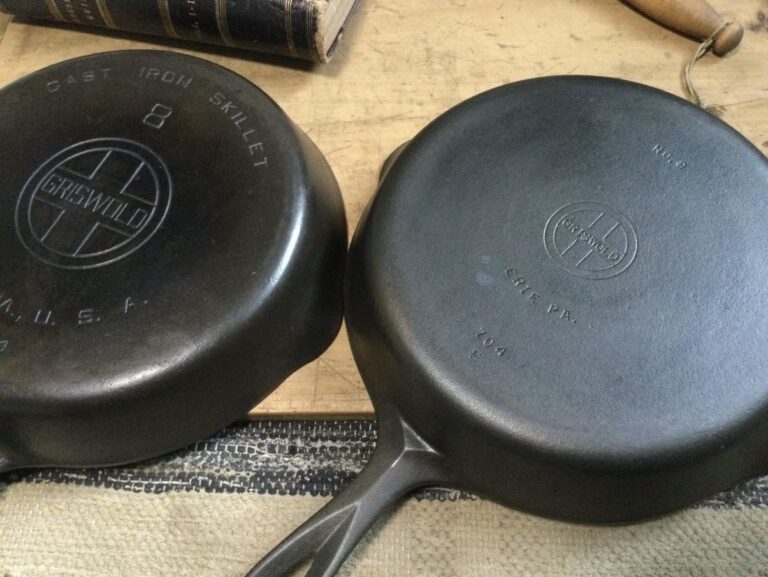
It keeps prices honest too. Griswold’s name recognition pushes its prices up at auction and estate sales, sometimes well past what the iron itself is worth. Wagner, despite matching or beating Griswold in quality, rarely commands the same premium. An unrestored piece can still be found for the price of a night out, and a properly restored one for not much more.
That’s what makes Wagner the honest choice — a company that built enough pans, well enough, that a century later there’s still plenty to go around.
If that sounds like a place to start, flea markets and estate sales are still where most of these turn up, often for less than you’d expect to pay.
Distinctive/Understated Look
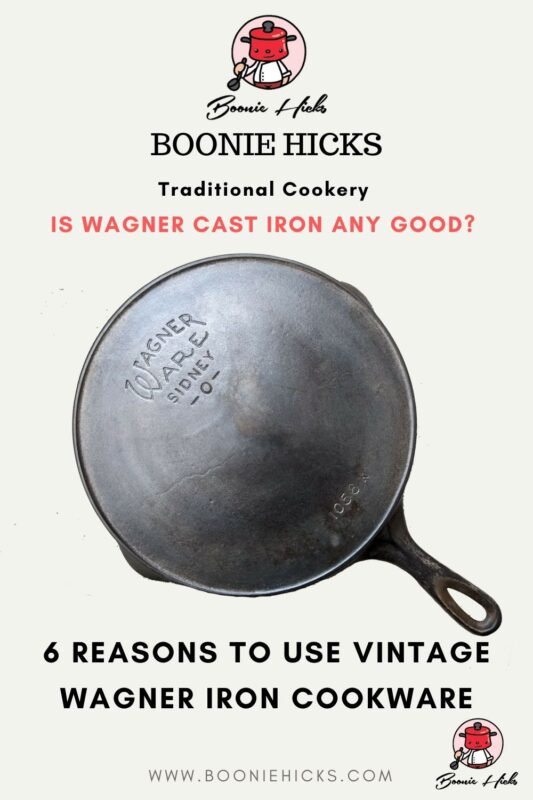
Flip an old Wagner over and its logo has an old-fashioned charm to it, whichever era you land on. Early pans wore a plain block “WAGNER,” straightforward and no-nonsense. Later ones carry the bold script “W” curling around “Sidney” and “O” that most collectors picture first — a look nobody’s really copying anymore. Either way, it stands out. It won’t blend in with whatever else is hanging on your shelf. Guests notice it, sooner or later somebody picks it up and asks about it, and that’s usually where the conversation starts.
Look closely and you’ll notice something else: two Wagner pans from the same era rarely match exactly. Before machines could cut a pattern the same way every time, someone at the foundry carved each logo by hand.
If the mark on your pan looks slightly different from a photo you’ve seen online, don’t worry — that’s expected. No two patterns were ever meant to match exactly.
Is Wagner Cast Iron Good?
Is Wagner cast iron good? By now the answer should be obvious, but it’s worth saying plainly: yes. A century-old company built its name on iron that was smoothed by hand, light enough to lift without thinking, and proud enough of its own work to put “Wagner” on the bottom of every piece.
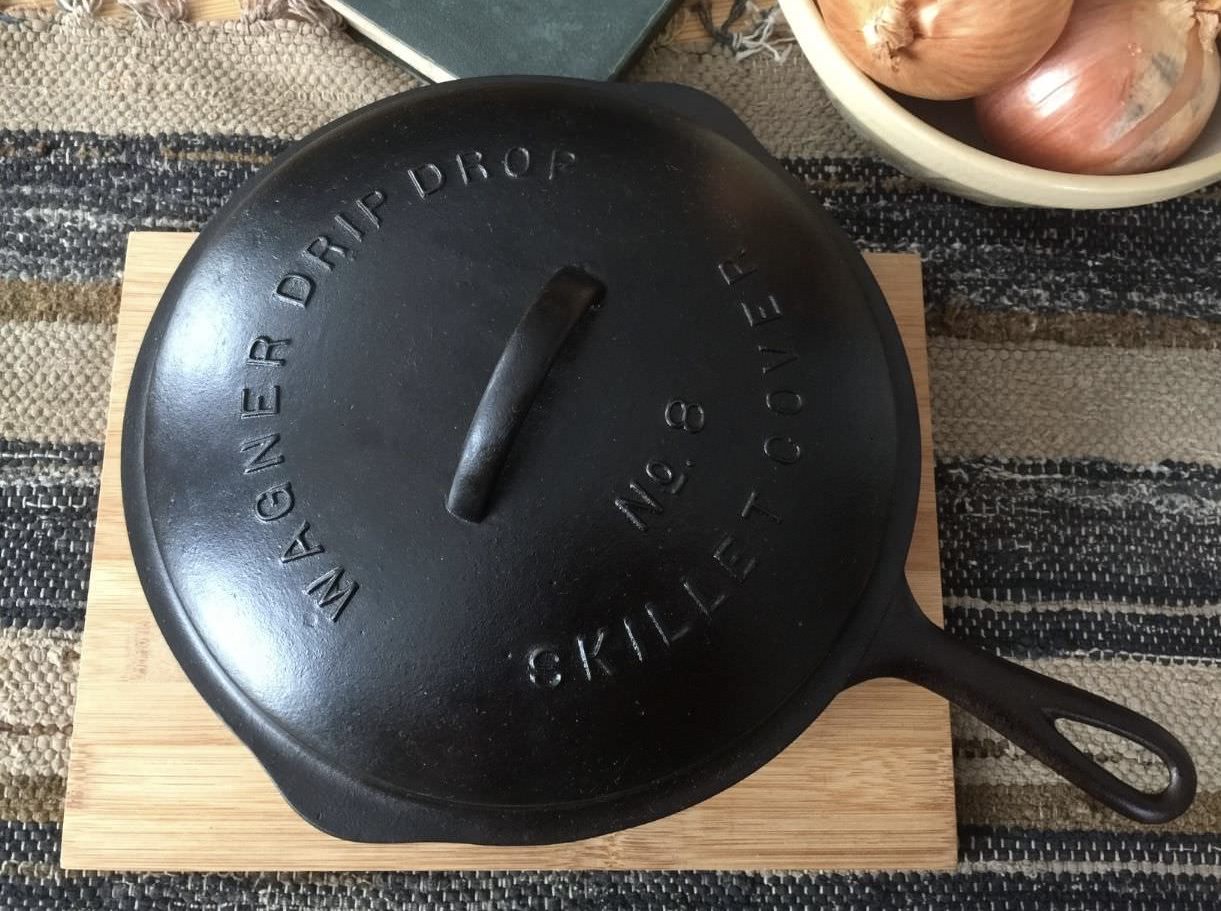
I’ve got a No. 8 straight-logo skillet of my own. It’s got scratches from years of use, no rust, and it still sits dead flat on the stove. It’s a tool I actually cook with, and that’s the point. A good pan is meant for the stove. This one’s still doing its job, scratches and all.
If you’ve got a Wagner in your kitchen, old or new to you, that’s the tradition it’s carrying — quality built to last long enough for someone else to still be using it.
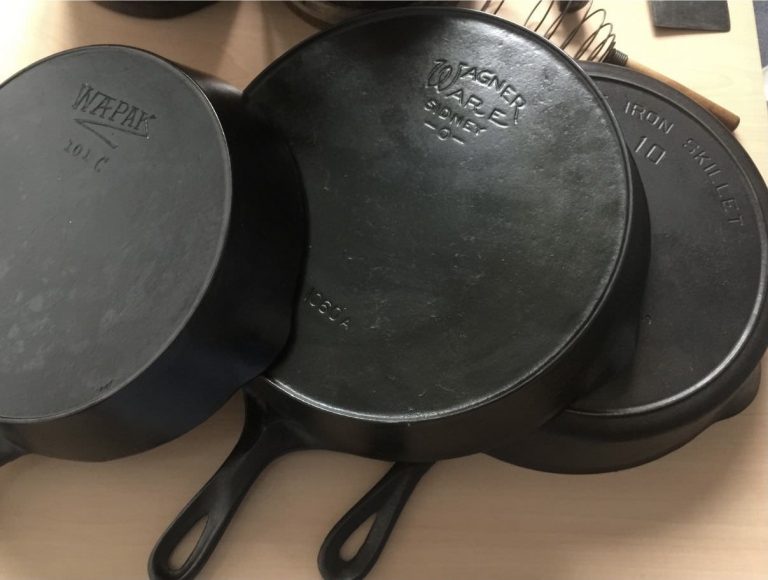
I found an old rusty Wagner Ware Sidney -O- skillet, It has an 8 on the handle, two pour spouts and the number 1058I on the bottom. It took a while to clean up and season but looks great. Can you tell what date this could have been made?
Hi Daniel
You’ll be able to compare the logo on your skillet with others on a Boonie Hicks article titled Wagner dates and logos.
Happy searching
Hi Boonie,
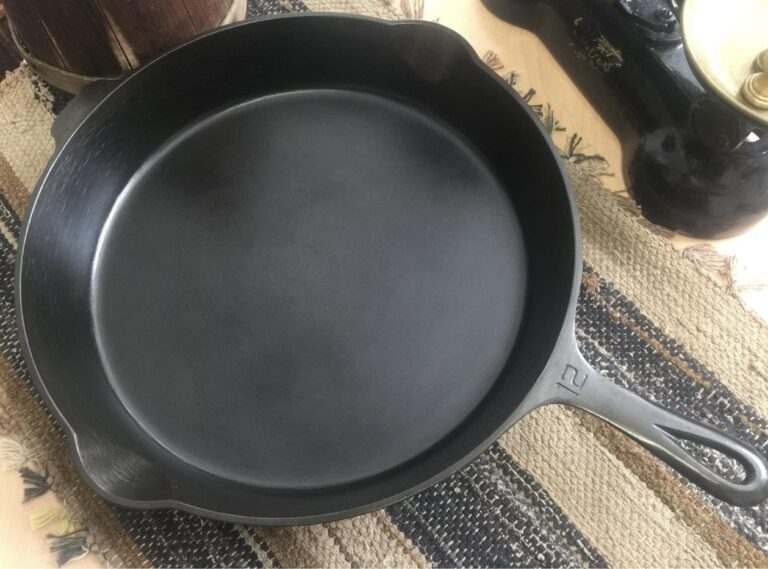
I have a vintage skillet, I purchased at an estate sale. It is marked 12 on the top of the handle, A on the bottom of the handle. It has a triangle wedge on the handle base, two large spouts, a tab opposite the handle and is marked 14 inch skillet on the base.
There is no makers name and no place of origin. From my different searches, I think it’s a Wagner pre-1960. Any suggestions how I confirm who made it and when? Any other info you might need?
Thanks Ellen
Hi Ellen
Thanks for getting in touch and for your detailed description.
From your description, it sounds like you have a vintage Wagner. A letter on the back of the handle, and the wording on the base is a strong indication of age and manufacturer. It sounds like you have a 1960s era Wagner.
Size 14, you’re very lucky.
Trust this helps.
Brett (Boonie)