Is Griswold Cast Iron Really That Good?
Is Griswold cast iron actually as good as collectors say, or is the reputation bigger than the pan itself?
The short answer is yes. Griswold earned its name honestly, and it’s still one of the most trusted brands you can put on a stove today.
But there’s a fuller answer, and it’s more interesting than a smooth cooking surface or a fair price at an estate sale. Walk into enough kitchens and you’ll notice a pattern. The Griswold skillet on the stove has usually been there for a while. It came from a grandmother’s kitchen, or a family home during a downsizing move. Someone kept it, used it, and eventually handed it down to someone else who does the same.
That’s the part a features list can’t explain. This article covers both sides: what makes Griswold genuinely good cookware, and why families keep passing the same pan down instead of buying a new one.
Griswold Cast Iron At A Glance
| Verdict | |
|---|---|
| Cooking Surface | Machined smooth, even heat distribution |
| Weight | Thinner and lighter than modern cast iron |
| Look | Homestead charm |
| Durability | Built to outlast generations |
| Collectibility | Sought-after, but usable pieces are still findable |
Table Of Contents
- Living Heritage
- Smooth cooking surfaces
- A Surface You Can Trust
- Lightweight
- Appearance
- Made to Last
- Is Griswold cast iron any good?
Living History
A Piece of Living Heritage
A Skillet Worth Passing Down
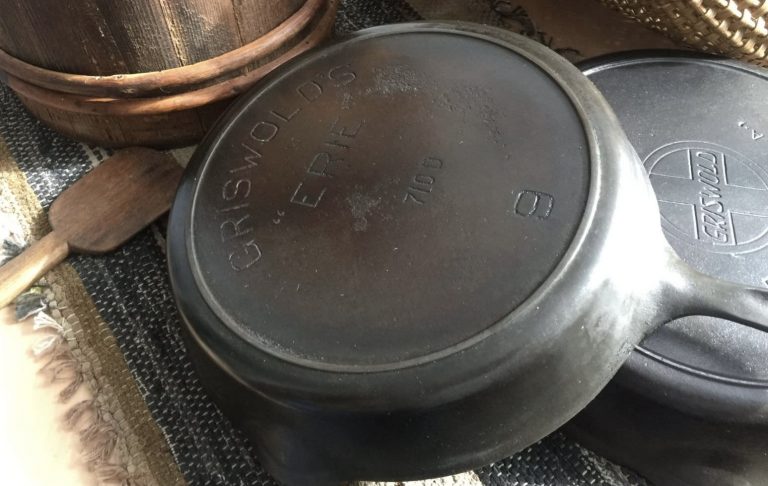
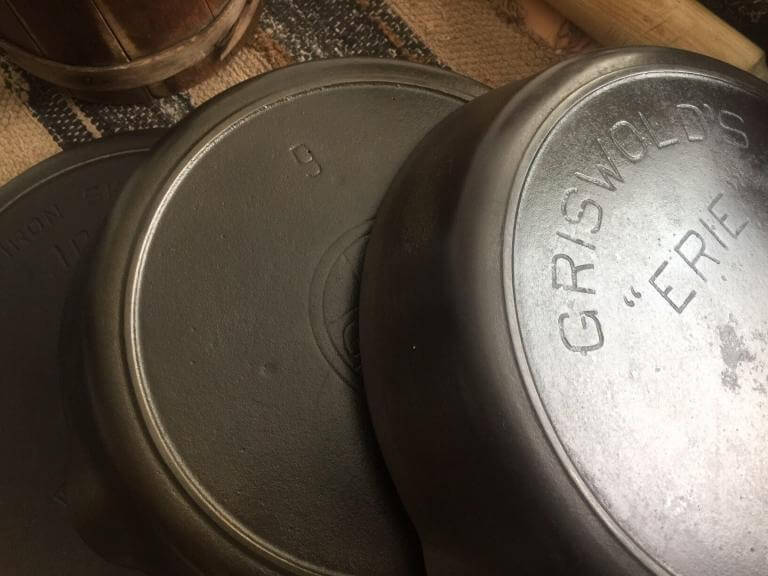
Griswold cast iron traces back to 1865, to a small foundry in Erie, Pennsylvania that started out making hinges and stove hardware, long before cookware entered the picture. When it did, the company stamped its early pans simply with “ERIE,” the name of the town, not yet the name people would come to trust. If your pan carries that mark, you’re holding something from the very beginning of the story.
A pan like that was never meant to be replaced. It was bought once, seasoned slowly over years of Sunday dinners and weekday breakfasts, and worn smooth in the places a hand rests most. By the time it was ready to hand down, the pan had become something more than cookware. It was a fixture of the kitchen itself.
This still happens today. Ask around, and most Griswold owners didn’t go looking for theirs at all. It showed up in a parent’s cupboard, or a grandmother’s kitchen, still dark with seasoning and ready to cook the moment it came home. It turned into a piece of family history without anyone planning for it, staying right where it was long after the people who first bought it were gone.
So when you set a Griswold on the stove, you’re adding one more meal to a pan that’s already fed generations.
Why Is Griswold Cast Iron Better?
Smooth Cooking Surface
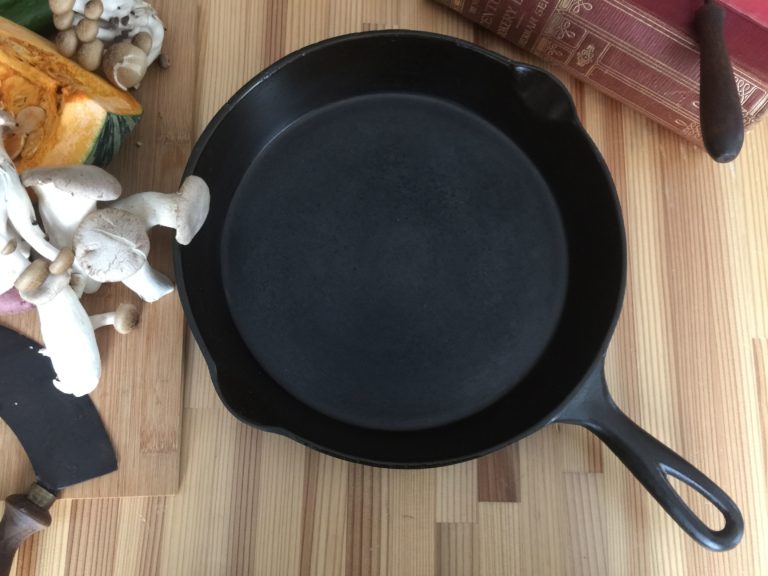
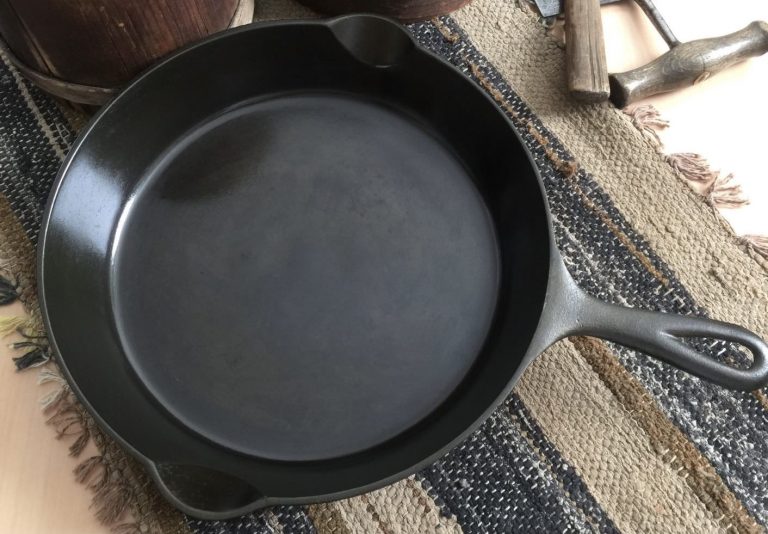
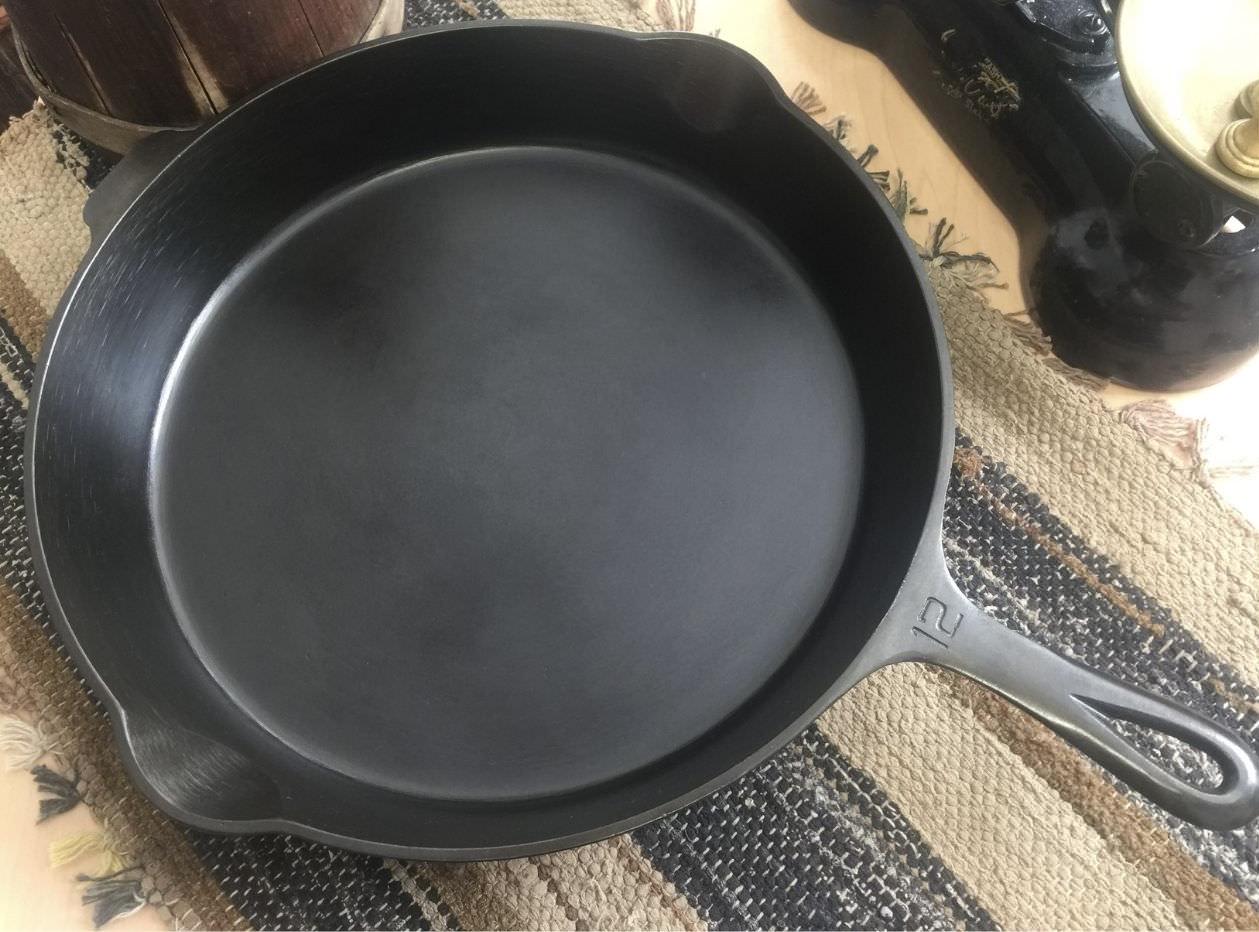
Run your hand across the inside of a good Griswold. The surface is smoother than most modern cast iron, and that’s not an accident. Before a Griswold pan ever reached a kitchen, it was machined smooth, grinding away the pebbly texture that sand-mold casting leaves behind. It was standard practice for foundries of the era. Modern mass production skips it now to keep costs down, which is why so much new cast iron feels rougher by comparison.
This smoothness does real work in your kitchen. Food that’s prone to sticking, like eggs or delicate fish, releases far more easily from a surface like this than a rough one. Seasoning builds faster too, since there’s less texture for it to fight against on its way to a slick, even coat.
You’ll notice it the first time you cook on one. There’s less resistance under a spatula, and none of the scraping sound that comes with a coarser pan. Small things, but they add up every time you’re at the stove.
A Surface You Can Trust
A Griswold pan has never needed a coating to work. What holds the seasoning is the iron itself, built up slowly, layer by layer, until the surface turns a deep, almost black sheen that only comes from years at the stove.
There’s an ease that comes with that. You reach for it without a second thought about scratches or a metal spatula, the same way people have cooked on one of these pans for well over a hundred years.
Trust like that wasn’t always rare. There was a time when nobody expected a pan to wear out. A Griswold still keeps that promise, quietly.
Lightweight
Pick up a Griswold next to a modern cast iron skillet of the same size, and the difference is obvious in your hand before you even start cooking. A vintage Griswold #8 typically runs about a pound and a half lighter than a comparable modern skillet, thinner-walled but no less capable. That difference matters more than it sounds like it should.
Cast iron has a reputation for being heavy. Full of food, it can be awkward to lift, and hard to maneuver one-handed while you’re plating something else on the stove. A Griswold sidesteps a lot of that. It’s still cast iron, still solid, but it doesn’t fight you the way a thicker modern pan can, especially once there’s a roast or a skillet of vegetables sitting inside it.
A lighter pan gets picked up more often, on ordinary weeknights and not just when there’s something to prove. It’s probably no accident that so many Griswolds remain in daily use, decade after decade, staying in your family instead of getting pushed to the back of a shelf.
Appearance
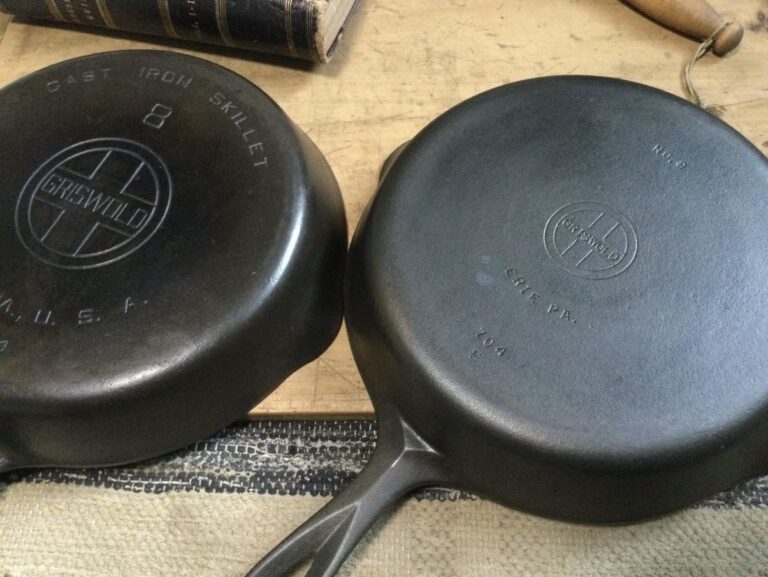
You can tell a Griswold from across the kitchen. The lettering on your pan is clear and crisp, sitting inside a cross-and-circle mark that’s evolved a little over the decades but never disappeared. Flip it over and you’ll likely find “ERIE, PA” beneath the name, a small detail that ties the piece in your hands back to the town where it was made.
If yours is an older piece, check the underside and you’ll probably see a heat ring, a raised edge circling the bottom. It wasn’t there for looks. Wood and coal stoves had uneven surfaces, and that ring let a pan sit flat and steady instead of rocking on a hot spot, back when a stove looked nothing like the one in your kitchen now.
Even the logo tells you something, once you know what you’re seeing. Griswold changed its lettering more than once over the years, from an early slanted script to a bolder, upright block. Somewhere in that shift is a rough idea of how old your pan actually is, and how many hands might have held it before yours.
Made to Last
Some of the Griswold pans in kitchens today are past their hundredth birthday, and they’re still frying eggs on a Tuesday morning, maybe in a kitchen not so different from yours. For a Griswold, that’s fairly ordinary.
Rust looks like the end. It isn’t. If yours has some, that layer sits on the surface of the iron, not inside it, which is why it comes off with steel wool and a little elbow grease rather than taking the pan down with it. Strip it back, season it again, and what’s underneath is the same solid iron it was the day it was cast, generations ago.
It comes down to what a pan is made of more than how it was treated. Most materials wear out. Iron just waits. Even a Griswold pulled from a shed after twenty years of neglect still has a working pan inside it, ready for you to bring back.
So, Is Griswold Cast Iron Good?
Yes. A pan that’s still searing steak and scrambling eggs a hundred years after it left the Erie foundry has already answered that on its own.
Heritage in a kitchen rarely announces itself. It shows up as a dark, worn handle, a surface that’s absorbed more meals than anyone bothered to count. The people who used it were just trying to get dinner on the table, nothing grander than that.
It’s sitting in your kitchen right now, whether you’ve thought of it that way before or not. Good enough to trust with dinner tonight, exactly like it always has been.
Related Articles For the Vintage Cast Iron Enthusiast
- List of the best vintage cast iron skillet brands
- Griswold logos and estimate the date
- Buying your first Griswold skillet
- Rare and sought-after pieces of Griswold cast iron
- Griswold history and timeline
- Where to buy your first Griswold ironware
Resources
- Wikipedia — Griswold Manufacturing
- The Cast Iron Collector — Griswold Manufacturing Co.
- The Cast Iron Collector — Cast Iron Cookware Finishing
- Stargazer Cast Iron — What Is the Ideal Weight for a Cast Iron Skillet?
- Washington Post — Every Cast-Iron Pan Tells a Story
- Cast Iron Collector Forums — Heat Distribution